—- —- PROPRIETARY DIAGNOSTIC FRAMEWORK
Five dimensions. One clear picture of your business.
Most business owners operate on instinct and fire drills. The VITAL Assessment gives you something better: a structured, unbiased diagnostic that shows exactly where your business is strong, where it is fragile, and what to address first.
Developed from 30 years of cross-industry operating experience — from shop floor to C-suite, in precision machining, aerospace, oil & gas, and professional services.
WHAT IS THE VITAL ASSESSMENT —————————————————————————————————————————————————————————————————————————-
Most advisors start with solutions. We start with a diagnosis.
The VITAL Assessment is a structured diagnostic engagement - typically 2 to 6 weeks - that produces a clear, prioritized picture of your business’s strengths, risks, and highest-leverage improvement opportunities. It’s designed for owners who want clarity before committing to a long-term engagement - and leads directly into the VITAL Strategy Session if you are ready to act on the findings.
PHASE 1
Discovery & Data Gathering
Structured interviews with owner and key leaders. Financial and operational data review. Org and accountability analysis
PHASE 2
Diagnostic Analysis
Scoring across all five VITAL dimensions. Pattern recognition across the business system. Identification of the root crux (actionable) issues vs. symptoms.
PHASE 3
Strategic Readout
Presentation of findings to owner and leadership. Prioritized action plan. Recommended engagement path forward.
PHASE 4
VITAL Strategy Session
A structured full-day facilitation built directly on your assessment findings. Using the Crux methodology and the DMV Operating Standard (Define, Meaning, Value), your leadership team identifies the pivotal issue blocking performance today, breaks it into solvable actions, and leaves with a prioritized plan - tied to the income statement - that they built themselves.
FUNDAMENTAL CONCEPTS————————————————————————————————————————————————————————————————————————————————————————
Why most business diagnostics miss the real problem
Most diagnostic frameworks look at what a business is doing. The VITAL Assessment also examines who is doing it, how they think, and whether the environment they work in supports sustained performance — or quietly undermines it.
Three bodies of research shape how we assess a business. We don't use academic language in the room — but understanding the principles explains why the methodology works when others don't.
CONCEPT 1
Cognitive Capability
Can your leaders actually think through their domain — or are they describing symptoms and proposing solutions without diagnosing the real problem? We assess four specific cognitive layers that determine whether a leader is genuinely capable of running their area independently.
CONCEPT 2
The Leadership Environment
Hiring capable people is only half the equation. Whether they stay engaged, keep developing, and perform at a high level over time depends on the environment your business creates. We examine whether your organization actively supports autonomy, competence development, and genuine team connection — or passively erodes them.
CONCEPT 3
Structured Decision-Making
Research in behavioral economics documents predictable cognitive failures in human judgment — status quo bias, anchoring, and confirmation bias among them. Even highly capable leaders are subject to these patterns. The VITAL methodology is built to surface and correct them before they distort priorities.
The result of addressing all three: a leadership team that is capable of running their domain, sustained by an environment that keeps them engaged, and equipped with a decision-making process that catches what the brain naturally skips.
THE FIVE DIMENSIONS ——————————————————————————————————————————————————————————————————————————————————————————
What we examine — and why it matters
Each dimension of VITAL reflects a critical lever in the business system. Weakness in any one area constrains all the others.
-
Vision is more than a mission statement on a wall. It’s the shared understanding of where the business is going, what it values, and what success looks like - at every level of the organization. Businesses with weak Vision suffer from misaligned priorities, inconsistent decision-making, and teams that pull in different directions. We assess whether your vision is documented, communicated, and operationalized - not just aspirational.
DIAGNOSTIC QUESTIONS
Can your leadership team articulate your 3-year picture without looking at a document
Do your quarterly priorities trace back to a concrete operational direction — not just a mission statement?
When leaders make day-to-day decisions, do those decisions reflect a shared direction — or individual judgment calls?
Is your vision specific enough to tell you what you will stop doing — not just what you are pursuing?
-
Business intelligence isn't about dashboards — it's about whether your data is accurate, timely, and actually used to drive decisions. We've worked with companies where the financials were weeks behind reality, where job costing was guesswork, and where owners were flying blind in $20M businesses. VITAL's Intelligence dimension examines your data infrastructure, reporting cadences, KPI discipline, and the quality of your business intelligence from shop floor to P&L.
DIAGNOSTIC QUESTIONS
Do you have a scorecard with 5–15 leading indicators reviewed weekly — ones that predict problems before they hit the P&L?
Can you determine within 48 hours whether last week was profitable — by product, by customer, by segment?
Are your pricing and job costing decisions based on actual data — or are they based on how it has always been done?
What data are you not collecting? Missing data is often the most important signal in the business.
When a leader presents a problem, can they attach a dollar figure to it — or do they describe it in operational terms only?
-
Do your leaders have the cognitive capability to lead their domain — and does your environment keep them engaged?
Right people, right seats is the starting point — not the destination.
The VITAL Team assessment goes two levels deeper than most frameworks. First, we assess whether your leaders have the cognitive capability to actually run their domain independently — not just whether they have the right title or enough years of experience. Second, we examine whether your business is creating the conditions for those leaders to stay engaged and keep developing over time — or whether it is quietly eroding the very performance you hired them for.
PART 1 - Domain Vision Competency
Every leader in a key seat must demonstrate four cognitive capabilities. This is not a personality assessment — it is a diagnostic of whether a leader can actually perform the core function of their role: see the real problem, understand its cause, and find a way forward.
Element Fluency - Does the leader know the component parts of their domain deeply enough to bound a problem precisely? Without this, they describe symptoms, not issues.
Systems Thinking - Can they see how their domain connects to and affects the rest of the business? Leaders who can't see the system optimize their area at the expense of the whole.
Diagnostic Capability - Can they identify root cause rather than proximate cause? This is the difference between solving the real problem and solving the same problem repeatedly.
Forward Sight - Can they see a path forward from the current state? Not vision — operational foresight. The ability to look at today's reality and identify the next move.
DIAGNOSTIC QUESTIONS
When your leaders describe a problem, are they describing what happened — or what caused it?
Can they tell you how their area connects to the P&L — with a dollar figure, not a general statement?
If a key issue surfaced in their domain today, could they resolve it without coming to you first?
Are they getting better at their job each quarter, or maintaining the same level they were hired at?
PART 2: THE LEADERSHIP ENVIRONMENT
Capability gets hired. Sustained performance has to be built. Research in motivational psychology is consistent: people move from technical compliance to genuine engagement when three fundamental needs are met — autonomy, competence, and relatedness. When those needs go unmet, capable people disengage — not dramatically, but reliably.
DIAGNOSTIC QUESTIONS:
Can your leaders make decisions in their domain without routing everything through you first?
When did a key leader last take on something meaningfully new — something that stretched their capability?
Does your leadership team trust each other enough to surface real problems in a room together?
If one of your best people was quietly disengaging, would you know — and would you know why?
If Team comes back weak in the VITAL Assessment, the first question is never “do we need to hire?” It is “which layer is missing, and what does that tell us about the path forward?” Sometimes the gap is capability. More often it is the environment that capability was placed into.
-
Most organizations have vision without accountability — great ideas that never get executed, rocks that roll over every quarter, and issues that are discussed but never resolved. Accountability is the operating cadence that converts intention into action. We examine your meeting rhythms, rock completion rates, issue-solving discipline, and whether your leadership team has built a genuine culture of ownership — not just compliance.
DIAGNOSTIC QUESTIONS
What percentage of quarterly rocks does your team complete on time — and what does that number tell you about execution culture?
When an issue is identified in a meeting, does it get defined precisely and assigned ownership — or discussed and tabled?
Does accountability flow in both directions — or only downward?
When someone misses a commitment, is the first conversation about what got in the way — or about what they will do differently?
-
Leverage is where operations meets enterprise value. A business with strong Leverage has documented processes, reduced owner dependency, diversified revenue, and scalable systems that make it attractive to a buyer — or capable of running without the founder in the room. As a CEPA-certified exit planning advisor, this dimension is where Brian's work connects operational performance to transaction readiness and long-term wealth outcomes for business owners.
DIAGNOSTIC QUESTIONS
Could your business operate for 30 days without you — and if not, which specific dependencies prevent it?
Are your core processes documented, followed, and improved on a defined cadence — or documented once and forgotten?
Is revenue concentrated in 1–2 customers or segments in a way that would concern a buyer or a lender?
Do you know your current enterprise value — and the specific operational factors that are driving it up or holding it down?
The VITAL Assessment is designed for owners who are ready for honesty.
This is not a feel-good engagement. The VITAL Assessment is a direct, structured diagnostic that surfaces uncomfortable truths alongside clear opportunities. If you’re looking for validation, this isn’t the right fit. If you’re looking for clarity — it might be the most valuable two weeks you spend this year.
+ Business owners in the $5MM-$50MM revenue range
+ Founders preparing for growth, scale, or eventual exit
+ Operators who feel something is wrong but can’t name it
+ Leaders who’ve tried EOS or other frameworks without full traction
+ Owners 2 - 5 years from a potential transition (in or out)
+ Manufacturing, industrial and professional service companies
Start with a VITAL Assessment
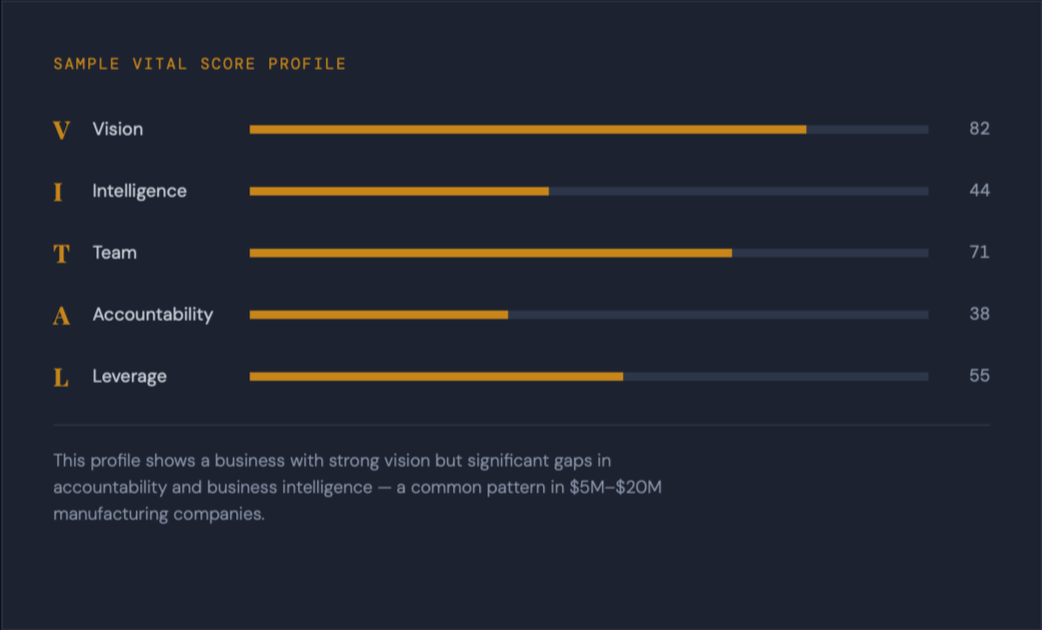
A structured 2 to 6 week diagnostic engagement that gives you a scored profile across all five dimensions, a prioritized action plan, and a clear recommended path forward.
- VITAL Score Profile with dimensions breakdown
- Written findings report with root-cause analysis
- Prioritized 90-day action plan
- Leadership readout presentation
Discovery calls are complimentary and take 30 minutes
From Diagnosis to Action: The VITAL Strategy Session
Your team is capable. The question is whether they’re focused on the right things.
Most leadership teams are working hard - and solving the wrong problems. Not because they are not smart or committed. Because without structured methodology to cut through opinion, history and internal politics, even the best teams default to what’s loudest instead of what matters most.
The VITAL Strategy Session gives you and your leadership team a structured, facilitated process to answer one question with precision: what are the highest-impact actions we can take in the next 90 days - and what has been getting in the way?
You bring the team. We bring the framework. The answers come from inside the room.
HOW IT WORKS :
This is not a consulting engagement where an outsider tells you what to do.
It is a structured facilitation - built around a rigorous diagnostic methodology - that guides you and your leadership team through a process of identifying, prioritizing, and committing to the actions that will actually move your numbers.
Every issue that surfaces gets run through a three-stage discipline: define it precisely, identify what the data actually tells you about root cause , and produce a specific action with ownership and a deadline. No issue moves forward without passing all three stages.
Every action that makes the final list must connect to the income statement within 12 months. Revenue growth, cost reduction, capacity increase, or risk mitigation. If it can’t be tied to a number, it doesn’t make the list.
The result is a leadership team that leaves the room with a short, prioritized, financially-grounded action plan - built by them, not handed to them.
THIS SESSION IS BUILT FOR YOU IF :
You are frustrated that execution doesn’t match the clarity you have at the top
Your leadership team is capable but can’t seem to prioritize the right things
You are tired of quarterly planning sessions that produce energy in the room but not results in the field
You want your team to own the solution - not just comply with a directive from above
You demand that every priority connect to a measurable financial outcome
You have no interest in a long consulting engagement - you want a structured process, a clear output, and the ability to execute it yourself
You have completed the VITAL Assessment and are ready to act on the findings
You are 2 - 5 years from a transaction and need a prioritized value-creation plan
WHAT THE SESSION PRODUCES :
The Crux - the pivotal issue blocking performance today - identified, defined and broken into solvable actions
A prioritized issue list ranked by income statement impact and feasibility - every item has a dollar figure attached
90-day rocks with clear ownership and measurable outcomes
A DMV resolution plan for each priority issue: precision definition, root cause analysis, and actionable path forward.
Income statement targets tied to every action - revenue gain, cost reduction, or capacity improvement within 12 months
A leadership alignment baseline your team can execute against immediately
The VITAL Strategy Session :
A structured full-day facilitation that conversts your VITAL Assessment findings - or your own read of the business - into a prioritized, income-statement-connected action plan with ownership and a 90-day accountability.
DELIVERABLES LIST:
Pre-work review and agenda design
Full-day on-site or virtual faciliation
Written output: prioritized issues, ownership assignments, 90-day rocks with deliverables
Income statement targets attached to every action item/rock
30-day follow-up check-in included